Facebook

16 Feb 2018

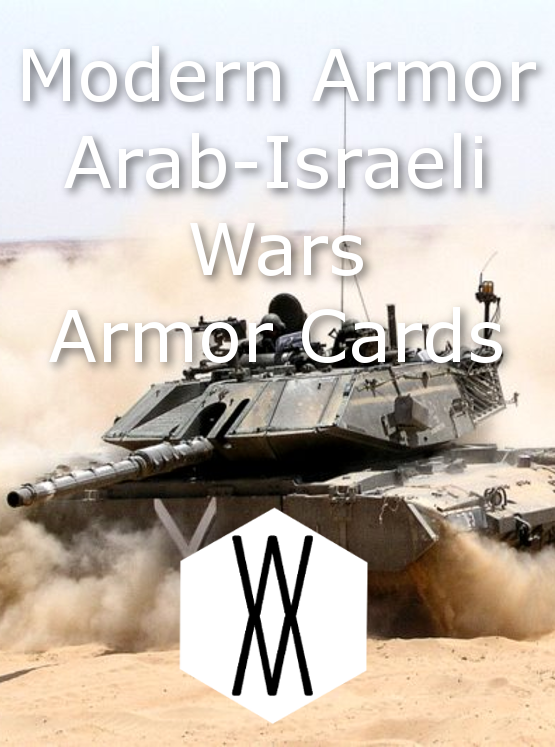
Modern Armor - Arab-Israeli Wars Armor Cards

Modern Armor - Arab-Israeli Wars Armor Cards

Modern Armor - Arab-Israeli Wars Armor Cards for the Modern Armor rule system.

Armor Cards for the armored fighting vehicles that participated in the Arab-Israeli wars: tanks, tank destroyers, infantry fighting vehicles, and anti-aircraft from 1948 through the 1982 Lebanon War, as well indigenous vehicles and local variations up to the present day.

Technical readout and weapon information for Modern Armor, including ballistic tables.

(These cards are not required to play the game)

Wargame Vault

10mm German Ritter (Knights) Released from Warmonger Miniatures

The German Ritter (Knights) are now available! Our sixth Kickstarter is all wrapped up and we’re now offering our seventh product up for sale to everyone!

10mm German Ritter (Knights)

10mm German Ritter (Knights) picture 1

10mm German Ritter (Knights) picture 2

10mm German Ritter (Knights) picture 3

10mm German Ritter (Knights) picture 4

10mm German Ritter (Knights) picture 5

10mm German Ritter (Knights) picture 6

10mm German Ritter (Knights) picture 7

Warmonger Miniatures

15 Feb 2018

Miniature Wargames 418, February 2018

Miniature Wargames 418, February 2018

FORWARD OBSERVER

What’s up and coming in (mostly) historical wargaming with reports on Warlord, Rubicon, Deep Cut and Caliver Books.

SEND THREE AND FOURPENCE

Part two of Civil War UK ‘79: Scenarios for Black Ops.

HELL BY DAYLIGHT

Part one of a set of rules for 20th Century Skirmish gaming by Jim Webster.

THE SANDS OF THE SUDAN

Starting a new period with a scenario and rules suggestions.

COMMAND DECISION

Can you get the troops home and safe? A commanding conundrum by Jon Sutherland.

DRAGONMEET

A trip to the London gaming show.

FANTASY FACTS

The usual holo-deck experience of the latest news in F&SF gaming with releases from Black Pyramid, Brigade, Slave2Gaming, Antediluvian Miniatures, Osprey and Outlaw Miniatures.

GONDOLIN GUARDS

Conversions and painting in the First age of Middle Earth.

CATALONIAN CAMPAIGN

Napoleon in Spain and the Battle of Valls: introducing the Powder and Sword rules.

RECCE

What’s wired and what’s tired in the latest book releases

WARGAMES WIDOW

On the carpet...

SIX ADDICTION

Can Andy Copestake make good decisions in his gaming? No dice!

CLUB DIRECTORY

Find a club in your vicinity and add your club for free!

Miniature Wargames

Medieval Warfare VIII-1, Feb-Mar 2018

Medieval Warfare VIII-1, Feb-Mar 2018

Medieval Warfare VIII.1 with John Hawkwood in Italy

This famous condottieri made a fortune as a military commander. How did an Englishman gain such fame in Renaissance Italy?

Theme: John Hawkwood in Italy

William Caferro, 'An English mercenary in Italy - The career of John Hawkwood'.
David Balfour, 'The massacres at Faenza and Cesena - The dark side of a hero'.
Sean Manning, 'The merchant of Prato's little secret - Hidden protections'.
Nick Bohmann, 'Why did city-states hire mercenaries - The dilemma'.
Niccolò Capponi and Kelly DeVries, 'Hawkwood's greatest victory - The Battle of Castagnaro'.

Features:

Kay Smith and Ruth R. Brown, 'Many questions with few answers - The longbow'.
Michael Livingston, 'If it even happened - The Battle of Hyddgen, 1401'.
Joanna Phillips, 'Why sieges were hard on your health - Besieging bodies'.
Georgios Theotokis, '11th century Norman mercenaries in the Mediterranean - Fame, faith, and fortune'.
Murray Dahm, 'Swords for hire, Hollywood style - Condottieri on film'.

Medieval Warfare

Wargames, Soldiers & Strategy, 95, Apr-May 2018

Wargames, Soldiers & Strategy, 95, Apr-May 2018

Wargames, Soldiers and Strategy issue 95 with Rome under pressure in Late Antiquity

Special Feature: Rome under pressure in Late Antiquity
Harry Sidebottom, 'The Late Roman Empire: History and wargaming - Changing to survive'.
Mark Backhouse, 'Northern Italy AD 271: A mini campaign - Aurelian and the Juthungi'.
Michael Leck, 'Don't make the Vandals angry - Escape from Rome'.
Daniel Mersey, 'A barbarian raid beyond the Limes - Crossing the bar'.
Guy Bowers, Building a Late Roman Army - Against the fall of night'.
Sascha Herm, 'Painting the cover - The Battle of Adrianople'.

Features

Jamie Gordon, 'Bitesize action in the Holy Land - Taking the cross'.
Steve Jones, 'A hypothetical AWI scenario - A fickle flanking force'.
Lon Teal and Ara Harwood, 'New goodies for Maximillian 1934 - If driving fast cars you like... anything goes'.
Mark Backhouse, 'A fictional platoon-level scenario in the Libyan Desert - Bir Achin'.
Dread Lunn, 'Painting a Russian SU assault gun - Weathering the Rasputitsa'.
Tony Harwood, 'A steam-powered bean engine - Building a Newcomen'.

Departments

Miniature reviews
Rick Priestley, 'Dedicated dabblers'.
Henry Hyde, 'Tabletop tactics - Horse and musket-era cavalry'.
Chris King, 'The irregular - Tracking the troops'.
Mark Backhouse, 'Skirmishing in the streets of an ancient city - Let's play Gangs of Rome'.
David Davies, Rossco Watkins, Guy Bowers, and Chris Payne, 'Game reviews - Outremer, Blood and Faith: Skirmish Level Crusading, Kobolds & Cobblestones, Wars of Insurgency, and 'Nam'.
Book reviews
Parting shots

Wargames, Soldiers & Strategy
Warhorses of Germany: The Myth of the Mechanised Blitzkrieg

Warhorses of Germany: The Myth of the Mechanised Blitzkrieg

While many films have attempted to convey the experience of the Second World War European battlefield, none adequately portray the mayhem and suffering that befell untold thousands of horses, their bodies impacted by bullet, flame and bomb as well as disease, starvation and backbreaking toil in the searing heat of summer and the freezing winds and snows of winter. In great part, the role of the horse in the Second World War, and in particular their use by the Third Reich, has been eclipsed by the sturm und donner of panzers and Stukas, the iconic images of the German mechanised Blitzkrieg.

In reality the so-called ‘military juggernaut’ was a myth – the Nazi war machine less metal and more horse flesh. While many of the horses were raised in military breeding centres, others were literally wrenched from farmers’ fields and strapped into harnesses, often fine-bred and unprepared for the rigours that awaited them.

The original photos in this book were in most part taken by German soldiers using their personal cameras to capture their special relationship with their four-legged comrades as well as recording the suffering and death they shared in a war that showed no mercy to any living thing, man or beast

The Battle of the Dnepr: The Red Army’s Forcing of the East Wall, September-December 1943

The Battle of the Dnepr: The Red Army’s Forcing of the East Wall, September-December 1943

The Battle of the Dnepr: The Red Army’s Forcing of the East Wall, August-December 1943', details a critical period in the Red Army’s advance along the southwest strategic direction during the general offensive that followed the fighting in the area of the Kursk salient in July-August 1943. The Germans, who were now on the strategic defensive in the East, sought to fall back and consolidate their front along the line of the Dnepr River. The Red Army’s success in overturning these expectations along this particularly important sector is the subject of this study.

This is a composite work based upon three studies carried out by the Red Army General Staff’s military-historical directorate, which was charged with collecting and analyzing the war’s experience. The first is a lengthy internal document, dating from 1946, which was eventually published in Russia in 2007, although heavily supplemented by commentary and other information not contained in the original. The present work omits these additions, while supplying its own commentary in places deemed necessary. Two short articles from another publication round out the collection.

The book is divided into two parts. The first deals with the efforts by General N.F. Vatutin’s Voronezh (later renamed First Ukrainian) Front to exploit the Soviet victory during the battle of Kursk and to carry the war to the Dnepr River and beyond. This involved pursuing the retreating Germans and attempting to seize crossings over the Dnepr in the Kiev area before the Germans could get across and consolidate their position. Although they were able to seize several small footholds, the Soviets were unable at first to expand them to bridgeheads of operational significance. By shifting their efforts to the bridgehead north of Kiev, the Soviets were eventually able to break out and capture Kiev, although a German counterattack from the Zhitomir area threw them back somewhat. Nevertheless, by the end of the year the Red Army in this area was ready to resume the offensive to retake the Ukrainian right bank.

The two articles, which comprise the second part, cover the combat operations of General I.S. Konev’s Steppe (later renamed Second Ukrainian) Front through Poltava and Kremenchug and to cross the Dnepr and seize bridgeheads south of Kiev. This is a more narrowly focused tactical-operational study, dealing with the efforts of the front’s 37th and 52nd armies to expand their positions on the Ukrainian right bank into operational bridgeheads capable of supporting a larger offensive to the west in 1944.