26 Oct 2018
The Units of Mythos of Legends
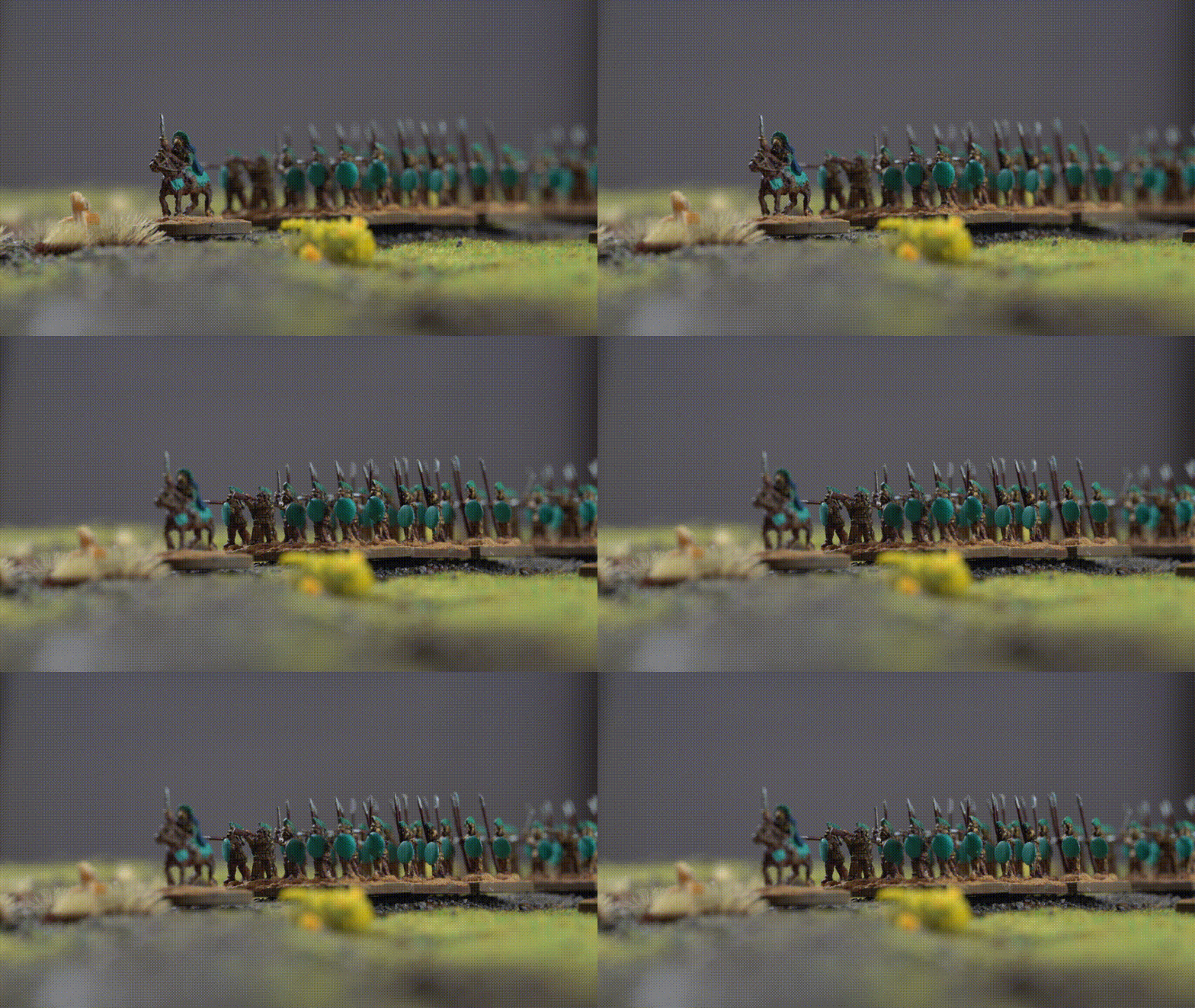
The core of a Mythos of Legends force! The units are placed upon the battlefield, where the majority of gameplay takes place and where your decisions and actions will determine glorious victory or magnanimous defeat. Units in the game are placed upon rectangular or square bases – described in game as formation units – or on round bases as Solo units.
Formation units represent all manner of warriors from across history and legend, from massed blocks of legionaries, to elite packs of hunters and huntsmen; from packs of trampling warbeasts, to hosts of charioteers; from troops of cavalry to devastating war engines; from hordes of cowed slaves, to towering monsters of unimaginable horror. Mythos of Legends draws them all into the fray. Solo units represent more specialist game pieces: Commanders who can enable players to pragmatically alter tactics mid-turn; mystics and mages who can enhance or undo the prowess of those around them; and specialist assassins and beasts who can stalk behind the enemy lines and cause havoc to an opponent’s battleplan.
Whilst the patron deity of you army will determine the chances of success for each action, the unit’s attributes, equipment and special rules that will help determine how many dice you will roll, and any other factors that may help or hinder your chances. A cunning general will know to build their army with complementary units to support and enhance their strategy, placing units in key positions to boost chances of success, to influence and modify the odds when the dice would otherwise be against them and to alter and redetermine decisions that would have already been set in stone.
Collecting a host of Units for Mythos of Legends couldn’t be easier or cheaper, with multiple army boxes being released for each faction as the Kickstarter stretch goals are met. With ten potential army sets to be unlocked across five factions, backing the Mythos of Legends Kickstarter is the fastest way to begin collecting the exciting armies of your choice, with all of the tokens you need to play included with the force.
The World of Lardello
Labels:
The World of Lardello
Location:
Victoria Rd, Middlesbrough TS1 3QJ, UK
Organ and Volley Guns from Warmonger Miniatures
I got the first WiP shots of the organ and volley guns from Bob. The organ gun (left) is looking close. It's going to get some additional barrel details and have the barrels moved up a bit. The volley gun (right) is getting reworked, it's looking too advanced at the moment with the metal case housing all the guns.
Organ and Volley Guns
Warmonger Miniatures
Organ and Volley Guns
Warmonger Miniatures
Labels:
Warmonger Miniatures
Location:
North Grafton, MA 01536, USA
25 Oct 2018
New 10mm Napoleonics from The Wargaming Company
We've got a couple new things to announce:
New 10mm Napoleonics
1813 ESR Starter Box Set
Having fought Revolutionary and then Napoleonic France more consistently than any other opponent, Austria sought to defy France's dominance on the battlefield. Austria walked away from its alliance with Napoleonic France and threw in its lot with the Coalition against France again in 1813, hoping to become the spoiler that could secure safety for its own empire as the Napoleonic period came to a bloody close.
One French Force Commander with Staff
One French Division
• One Formation Commander
• Two Légère Infantry Battalions
• Six Ligne Infantry Battalions
• One 6-pdr Foot Artillery Battery
• One Reformation Area
One French Cavalry Regiment
• One Formation Commander
• Two Chasseur à Cheval Squadrons
• One Reformation Area
One Austrian Force Commander with Staff
One Austrian Division
• Two Grenzer Battalions
• Six Infantry Battalions
• One 6-pdr Foot Artillery Battery
• One Reformation Area
One Austrian Cavalry Regiment
• One Formation Commander
• Three Chevaulégèr/Dragoon Squadrons
• One Reformation Area
Battleflags
• Eight French Infantry Flags
• One French Chasseur à Cheval Flag
• Eight Austrian Infantry Flags
• One Austrian Chevaulégèr/Dragoon Flag
Bases
• Two 30mm Round Bases
• Four 20mm Round Bases
• Twenty-Three 30x30mm Bases
• Six 30x90mm Bases
Approximately 250 metal 10mm (1:160 scale) miniatures with bases and flags.
Product designed for use with ESR Second Edition, may be compatible with other game systems but compatibility is not intended by design.
May contain lead and small parts, not suitable for children under 14. Contents may differ from photos provided here. Provided unpainted and unassembled.
1814 ESR Starter Box Set
Prussia came to symbolize the moral will behind the war against Napoleon. The French had taken revenge for the Seven Years War in 1806 and now Prussia sought to take revenge for 1806. With an Army largely comprised of citizen militia, and arms supplied by Russian and England, Prussia confronted a French Army comprised of war-weary veterans and enthusiastic but untrained conscripts, in a bitter war of conquest and survival.
One French Force Commander with Staff
One French Division
• One Formation Commander
• Two Légère Infantry Battalions
• Six Ligne Infantry Battalions
• One 6-pdr Foot Artillery Battery
• One Reformation Area
One French Cavalry Regiment
• One Formation Commander
• Two Chasseur à Cheval Squadrons
• One Reformation Area
One Prussian Force Commander with Staff
One Prussian Brigade
• One Fusilier Battalion
• Two Infantry Battalions
• Two Reserve Infantry Battalions
• Four Landwehr Infantry Battalions
• One 6-pdr Foot Artillery Battery
• One Reformation Area
One Prussian Cavalry Regiment
• One Formation Commander
• Three Hussar Squadrons
• One Reformation Area
Battleflags
• Eight French Infantry Flags
• One French Chasseur à Cheval Flag
• Two Prussian Infantry Flags
• Four Prussian Landwehr Infantry Flags
Bases
• Two 30mm Round Bases
• Four 20mm Round Bases
• Twenty-Three 30x30mm Bases
• Four 30x90mm Bases
Approximately 250 metal 10mm (1:160 scale) miniatures with bases and flags.
Product designed for use with ESR Second Edition, may be compatible with other game systems but compatibility is not intended by design.
May contain lead and small parts, not suitable for children under 14. Contents may differ from photos provided here. Provided unpainted and unassembled.
Prussian Late War ArmeeKorps
Prussian Grenadiers
Prussian Küirassiers
Prussian Dragoons
Prussian Light Cavalry
Prussian Artillery Reserve
Austrian Late War ArmeeKorps
Austrian Infantry Brigade
Russian Uhlans
Russian Ural Cossacks
French Chevaulégèr-Lanciers
French Hussards
These will be available for pickup at Fall-In 2018! Otherwise, they are scheduled to begin shipping the end of November.
The Wargaming Company
New 10mm Napoleonics
1813 ESR Starter Box Set
Having fought Revolutionary and then Napoleonic France more consistently than any other opponent, Austria sought to defy France's dominance on the battlefield. Austria walked away from its alliance with Napoleonic France and threw in its lot with the Coalition against France again in 1813, hoping to become the spoiler that could secure safety for its own empire as the Napoleonic period came to a bloody close.
One French Force Commander with Staff
One French Division
• One Formation Commander
• Two Légère Infantry Battalions
• Six Ligne Infantry Battalions
• One 6-pdr Foot Artillery Battery
• One Reformation Area
One French Cavalry Regiment
• One Formation Commander
• Two Chasseur à Cheval Squadrons
• One Reformation Area
One Austrian Force Commander with Staff
One Austrian Division
• Two Grenzer Battalions
• Six Infantry Battalions
• One 6-pdr Foot Artillery Battery
• One Reformation Area
One Austrian Cavalry Regiment
• One Formation Commander
• Three Chevaulégèr/Dragoon Squadrons
• One Reformation Area
Battleflags
• Eight French Infantry Flags
• One French Chasseur à Cheval Flag
• Eight Austrian Infantry Flags
• One Austrian Chevaulégèr/Dragoon Flag
Bases
• Two 30mm Round Bases
• Four 20mm Round Bases
• Twenty-Three 30x30mm Bases
• Six 30x90mm Bases
Approximately 250 metal 10mm (1:160 scale) miniatures with bases and flags.
Product designed for use with ESR Second Edition, may be compatible with other game systems but compatibility is not intended by design.
May contain lead and small parts, not suitable for children under 14. Contents may differ from photos provided here. Provided unpainted and unassembled.
1814 ESR Starter Box Set
Prussia came to symbolize the moral will behind the war against Napoleon. The French had taken revenge for the Seven Years War in 1806 and now Prussia sought to take revenge for 1806. With an Army largely comprised of citizen militia, and arms supplied by Russian and England, Prussia confronted a French Army comprised of war-weary veterans and enthusiastic but untrained conscripts, in a bitter war of conquest and survival.
One French Force Commander with Staff
One French Division
• One Formation Commander
• Two Légère Infantry Battalions
• Six Ligne Infantry Battalions
• One 6-pdr Foot Artillery Battery
• One Reformation Area
One French Cavalry Regiment
• One Formation Commander
• Two Chasseur à Cheval Squadrons
• One Reformation Area
One Prussian Force Commander with Staff
One Prussian Brigade
• One Fusilier Battalion
• Two Infantry Battalions
• Two Reserve Infantry Battalions
• Four Landwehr Infantry Battalions
• One 6-pdr Foot Artillery Battery
• One Reformation Area
One Prussian Cavalry Regiment
• One Formation Commander
• Three Hussar Squadrons
• One Reformation Area
Battleflags
• Eight French Infantry Flags
• One French Chasseur à Cheval Flag
• Two Prussian Infantry Flags
• Four Prussian Landwehr Infantry Flags
Bases
• Two 30mm Round Bases
• Four 20mm Round Bases
• Twenty-Three 30x30mm Bases
• Four 30x90mm Bases
Approximately 250 metal 10mm (1:160 scale) miniatures with bases and flags.
Product designed for use with ESR Second Edition, may be compatible with other game systems but compatibility is not intended by design.
May contain lead and small parts, not suitable for children under 14. Contents may differ from photos provided here. Provided unpainted and unassembled.
Prussian Late War ArmeeKorps
Prussian Grenadiers
Prussian Küirassiers
Prussian Dragoons
Prussian Light Cavalry
Prussian Artillery Reserve
Austrian Late War ArmeeKorps
Austrian Infantry Brigade
Russian Uhlans
Russian Ural Cossacks
French Chevaulégèr-Lanciers
French Hussards
These will be available for pickup at Fall-In 2018! Otherwise, they are scheduled to begin shipping the end of November.
The Wargaming Company
Labels:
The Wargaming Company
The Gods of Mythos of Legends
When you take to the battlefield in Mythos of Legends, your army must include a patron deity Miniature for your faction. The deity you chose has possibly a more significant influence over the battle than any other factor that you can directly control, since the deity you select will determine your army’s strengths and potential weaknesses.
In many wargames, the effectiveness of a unit is determined by its own rules and stats alone. The way in which Mythos of Legends works is slightly different, in that your unit’s chance of success is also determined by your faction’s deity. Let’s take a look at Zeus and Athena:
When players take any stat tests, they will be compared against the above four statistics – or stat – values. When a player rolls any dice, the result rolled is compared against their chosen deity’s target score, and if it matches or beats it the die is considered a success. If it’s under the score it’s a fail. It doesn’t matter whether it’s your Hoplites, your Archers or your War Elephants, they all roll against the deity’s target score.
Any tabletop veterans should hopefully see the immediate impact of changing Zeus for Athena or vice versa at a glance, and the impact of having a variety of deities available to all factions will have upon Mythos of Legends as a game. You want a game where your strategy focuses on shooting and strategic repositioning? Athena is the Goddess for you. You want to unleash fury and devastation in up-close engaged combat? Ares has you covered. You want a balance, to reflect against all you may face? Zeus will guide you to victory.
Through this mechanic, players can change their entire game style in an inexpensive and pleasant way by collecting and modelling a diverse range of high-quality detailed figures for their chosen pantheons. Want a different playstyle? Just try a different deity. Substance and style in equal measure.
During the game the role of the gods comes to the fore at the start of each turn. During the Mythos Phase the players move their deities on the Mythos Board, to determine which bonuses and penalties that their army will have this turn, all dependent on the whims of their patron god. Each deity also comes with a plethora of Divine Interventions for players to attempt to access. These abilities are drawn from legends, sagas, fables and novels relating to each being and can have a dramatic impact upon the battle unfolding below. These powers are as varied and dynamic as each individual god and goddess. Powers such as “The Eye of Horus” can enhance the power of the units under his patronage, Neptune’s “Bringer of Earthquakes” can destroy the ranks of enemy directly and Odin’s powers to resurrect the dead is always helpful mid battle.
However, the will of the Gods is fickle. Players must gamble their precious Mythos Dice and hope to meet the demanding target scores needed to draw down the power of the gods. However, if you can beat the odds the rewards can change a battle in a roll of the dice. There’s always a chance to bring it back when you have faith on your side.
The World of Lardello
Labels:
The World of Lardello
Location:
Victoria Rd, Middlesbrough TS1 3QJ, UK
Miniature Wargames 426, October 2018
• Another WWII duo. The Western Desert with Gallalabat and the far east with Tarakan: another Command Decision conundrum by Jon Sutherland.
• An exciting preview of our upcoming show, Tabletop Gaming Live
• Stop Motion: Mediterranean Mythology Gaming the Harryhausen way!
• 1/300th gaming: multi period scenarios and suggestions with The Virtuous Soldier and The Troops that you Lead
• Fiction from Friction: some thought provoking command and control ideas.
• Wargames Widow builds herself a big ‘ole church in 54mm!
• In Send Three and Fourpence there’s With the Colours: the computer moderated rules with and a campaign system and lots of toy soldiers to boot!
Miniature Wargames
Medieval Warfare VIII-5, Nov-Dec 2018
Medieval Warfare VIII.5 with The Umayyad Caliphate versus the Byzantine Empire (674-718)
Before its fall in 1453, Constantinople would be subjected to numerous sieges, including two early offensives by the Umayyad Caliphate in the 7th and 8th centuries.
Theme: The Umayyad Caliphate against the Byzantine Empire (674-718)
Peter Konieczny, 'Against the Empire - The Arabs bring war to Byzantium.'
Georgios Theotokis, '“They did the same thing for seven years” - Was Constantinople besieged in 674-78?'
Randall Moffett, 'Defenders of the Empire - The Byzantine soldier in the eighth century.'
Georgios Chatzelis, 'Knowledge that kills - Byzantine military manuals and warfare.'
Michael Edward Stewart, '"A furious storm fell upon them - The Arab siege of Constantinople, 717-718.'
Kay Smith and Ruth R. Brown, 'The first chemical weapon? - Playing with Greek Fire'
'Readings: Byzantium during the rise of Islam.'
Features:
Alexander R. Brondarbit, 'The siege of Harlech castle - Resistance in Wales during the Wars of the Roses.'
Kyle C. Lincoln, 'An innumerable multitude of livestock - An archbishop and his cavalry.'
Stephen Turnbull, 'The king of Spain's samurai - Fighting for the Philippines in the 16th century.'
Leigh Whaley, 'Controversial treatments - The surgeons who tried to change Medieval battlefield surgery.'
Murray Dahm, 'A band of Merry Men - Douglas Fairbanks' 1922 Robin Hood.'
Medieval Warfare
24 Oct 2018
The Factions of Mythos of Legends
Each miniature that is created will belong to one or more factions within the Mythos of Legends system. This is to help differentiate and create diverse and rich gaming experiences which revolve around a theme or narrative, but practically it also helps maintain a degree of fairness and balance across the system and make for a more enjoyable experience for all. Each faction has been built upon pre-existing myths, stories and legends that have developed across the millennia, making the collecting and gaming experience recognisable and exciting to all who wish to embrace the Mythos of Legends. In this section, we hope to provide an overview of the five factions we wish to unlock over the course of the Kickstarter campaign. Objectively, we plan to start with two – Ancient Rome and Ancient Greece – with the target of unlocking the rest through Kickstarter pledges.
Each faction has been designed to offer a variety of play styles within the army faction rules. These rules will be available for free on this website upon the completion of the Kickstarter fulfilment and the release of backers miniatures, but they have already been written to ensure all backers will receive a fantastic gaming experience as soon as possible. We’ll be discussing how each faction is different during the Kickstarter campaign and exploring the system rules in greater depth, so watch this space for lots more exciting information.
To find out more about the Kickstarter, please click the link below:
Ancient Greece
It is a time of great heroes and legendary monsters, demigods and great quests. When the Lords of Olympus raise the call to arms, the Greek City States answer. The indomitable heroes of the age stride to war alongside the beasts that they would normally find themselves slaying, alongside massed ranks of spear and pike.
The Greek army takes the field built around solid blocks of defensive infantry, the Hoplites and Phalangites, who present a deadly wall of pikes to their enemy. They are ably supported by archers, skirmishers and cavalry which can harass the enemy’s flanks and defend those of their own unwieldy phalanxes.
The heart of the army, though, is the legendary units. Powerful figures which stride out of legend to lead their mortal brethren. Heroes of the epic tales such as Achilles, Odysseus and Heracles will strike fear into the heart of any enemy, and the likes of the Gorgons, Cyclops and Hydra can tear through mortals with barely a pause. They are the hammer, to the anvil of the phalanxes.
Given the focus of the Greek list on its legends, the Greek player can take more legendary units than any other faction. And given what they can do, why wouldn’t you? This is a faction for the player who wants to see their legendary heroes striding the board, tearing apart the enemy single-handed. Who can stand in their way?
Ancient Rome
Rome stands as a bastion of mankind against the supernatural, blessed, damned and divine powers of the world. Not for them the beasts or demigods within their ranks. No, a Roman army works on flesh and blood, iron discipline, inspired generalship and cold, hard steel. No matter the origin, there is little that can take on a legion and emerge triumphant. The Roman people – and gods – will it to be so.
Roman units can come in two flavours – the Hastati, Principes, Triarii model of the Republican legions or the later legions of the Empire following the reforms of Gaius Marius. Whichever troops the player uses, the citizen soldiers of Rome remain versatile and steadfast.
The Roman army can easily field more units of high-quality infantry than other factions, armed with versatile swords and javelins to respond to any foe. They can pass their generals’ orders along the line, giving the Roman player an unprecedented degree of tactical flexibility when compared with other factions.
Backing up the legions are the auxiliaries, a wide array of useful support troops able to plug any skill gaps that the legions lack, and a selection of powerful war machines capable of reaching out and striking the enemy from afar.
The Roman faction is best suited for the player who isn’t interested in demigods or monsters, but who would rather field large groups of quality infantry and win the day through tactical flexibility, discipline and the strength of a legionary’s sword arm.
Ancient Egypt
Pharoah’s will be done.
The Egyptian army is one based around its king, the living God who rules over the lives and souls of all of his subjects. The Pharoah takes to the battlefield in glory, and his people follow.
The Egyptian army follows a unique mechanic, the Balance of Maat. Egyptian priests can call on a wide variety of powerful spells and rituals, but each one of these either brings more order or disorder to the world. These rituals can bring great benefit to the Egyptian army, but the Pharoah (and the Egyptian player) must strive to keep order and disorder in balance, for no army can truly emerge victorious with Maat unsatisfied.
The Pharoah is undoubtedly the centre of the army, accompanied by his Princes. If the Pharoah should be slain, one of the Princes may rise to the task and assume the mantle of Pharoah to continue the struggle.
They command varied forces including powerful chariots, skilled and experienced guard units, and terrified slave soldiers forced to battle by their masters’ whims. The Pharoah’s divine will can also cause the mythical creatures of his homeland to follow him into battle. The likes of Sphinxes, Griffons and Serpopards can often be found in the Egyptian army, presenting a daunting challenge to anybody who wishes to defy them.
The Egyptian player therefore has access to an interesting variety of troops, monsters and priests, all going to war to support their divine king, with mystical abilities to terrify their enemies.
Dark Age Pagans
Many different peoples are loyal to the Gods of Asgard. The likes of the Vikings, Visigoths, Ostrogoths and Alemanni are disparate peoples who come together at the instruction of their divine lords to wage furious war on the outsiders. One thing they all have in common – the various tribes live life hard, and have become hard peoples as a result. The Dark Age Pagan faction has access to brutally effective troops, fighting with a Northern Fury.
Their units aren’t as large as those that some of their enemies field, but they make up for it with individual strength and skill at arms, and the leadership of their chieftains. Where other armies increase the size of their units to make them stronger, the armies of the Asgard pantheon instead add Chieftains, which make an already hard-hitting unit even deadlier. If the Asgard player can get their troops into combat, the enemy will feel the pain. But they must be careful, since the reduced number of models means that wounds are felt severely.
The forces of Asgard do not need deadly monsters to bolster their ranks, since the mortals are deadly enough – though these creatures can still be a dangerous addition to their strength. Also useful to these hardened warriors are the likes of the soothsayers and dwarves, who possess abilities to bolster the Asgard player or compromise the plans and units of their enemy.
The Dark Age Pagan faction is best suited to a player who wants the enemy to be afraid of even their basic troops, with small units of deadly warriors backed up by sorcerous creatures who can make their impressive charge even deadlier.
Eldritch Abominations and the Cults of the Elder Gods
This way madness lies.
Many had forgotten the ‘Beings from Beyond’, but enough remember. Foul creatures are spawned in the deep and remote places of the world, and whispers enter the heads of mortals speaking incantations that they cannot begin to fathom. Cults blossom, digging tendrils into the underworlds of all nations, their rulers oblivious to the dangers within.
When these cults take to the field of battle they can lead armies made up from the very peoples who fight against them. Cultist armies have access to some units from the other factions, mortal soldiers who have fallen into the worship of these Eldritch Gods, who feed the strength of the cult with their devotion. Creatures such as the Deep Ones, Shoggoths and Night Gaunts emerge from nowhere to battle alongside their mortal brethren. All fight with a tenuous grip on sanity.
Madness is contagious where the ‘Beings from Beyond’ are involved. The armies who fight against them have to be constantly on their guard, not to let the Eldritch horror into their minds, to turn them into gibbering wrecks.
The hallmark of this faction is its unpredictability and insanity. Cultist players can spread madness to the ranks of their enemies with chanting hordes and priests of forbidden lore. The creatures who follow the army can do strange and disturbing things, able to catch the enemy off their guard. The Cults of the Elder Gods are a faction for the player who takes delight in destroying their enemy’s battle plan from inside out, manipulating the enemy’s troops and threatening flanks that the enemy had no idea were even under threat.
The World of Lardello
Labels:
The World of Lardello
Location:
Victoria Rd, Middlesbrough TS1 3QJ, UK
Subscribe to:
Posts (Atom)