Facebook

16 Nov 2017

Prototype Boards from TTCombat

Here is a little preview of some of the boards we have been making for Dropzone commander

Prototype Boards from TTCombat

TTCombat

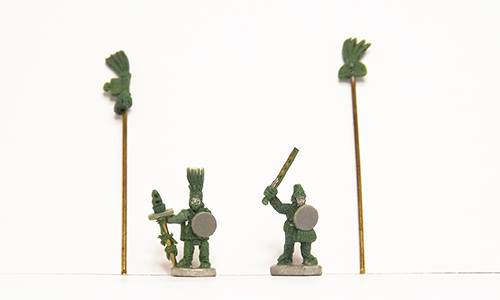
First look at the Aztec Sculpts from Pendraken Miniatures

Phil's been quietly working away on this project for some time now, adding a sculpt here and there as he's been working on other things for us.  But the good news is that they're all done now and we've got them here at Pendraken HQ!  One person who will be rather excited by this (and is largely responsible for these becoming a reality) is Fierce Kitty, so we hope he likes them!  We'd like to thank him for all of his time and effort helping us out with this range as well, chatting with Phil about the design side and then with me to put the range lists together.  This lot will be getting master moulded in the next few weeks and should be ready for release early in the New Year.

Command

Command

Jaguar warriors/Tzitzimitl

Jaguar warriors/Tzitzimitl

Eagle warriors

Eagle warriors

Quachic fanatic veterans

Quachic fanatic veterans

Tequihuah veterans

Tequihuah veterans

Huaxtec warriors/Priests

Huaxtec warriors/Priests

Commoners

Commoners

Commoners with bow/slings

Commoners with bow/slings

Commoners with baggage

Commoners with baggage

Chief of Men

Chief of Men

Tzilacatzin, Warrior champion

Tzilacatzin, Warrior champion

Mixed standards

Mixed standards

Forum Discussion
Pendraken Miniatures

15 Nov 2017

Late medieval To Napoleonic Wargame Scenery For 6, 10, 15, 20 & 28mm


A complete set of scenery for the medieval to Napoleonic period wargames for the 6, 10, 15, 20 & 28mm. Blueprint .stl available.

About

Offer for the last 72hours !

Attention, limited to 5!

Happy New Year and thank you all !

UK

With the success of the first project, I decided to continue on my launch by making you enjoy the many new scenery for the late medieval period at the end of the 19th century. With the experience of many creations and the conclusive crash test, you will find that the quality of these sets is even better! The details are more and more pushed up the scales, while choosing a compromise between simplicity of printing and visual rendering. Personally, I use a lot 1: 72. So you will see a lot of photo sets on this scale even though they have been tested in all scales. Let's move on to the different contributions.

FR

Fort de la petite réussite du premier projet, j’ai décidé de continuer sur ma lancé en vous faisant profiter des nombreux nouveaux décors destinés aux périodes de la fin du moyen âge à la fin du 19ème siècle. Grâce à l’expérience de nombreuses créations et au crash test concluant, vous constaterez que la qualité de ces décors est encore meilleure ! Les détails sont de plus en plus poussés en montant dans les échelles, tout en choisissant un compromis entre simplicité d’impression et rendu visuel. A titre personnel, j’utilise beaucoup le 1 :72ème. Vous verrez donc beaucoup de décors en photo à cette échelle même s'ils ont été testé dans toutes les échelles. Passons aux différentes contributions.

Blueprints only !
Blueprints only !
Physical with stl in option!

Example of the starter in 6mm.

 starter in 6mm
starter in 6mm

 Make a little tour in details.

Late Medieval to Napoleonic Period Scenery

Patron
Patron

£400 Stretch Goal
£400 Stretch Goal
£600 Stretch Goal
£600 Stretch Goal


£800 Stretch Goal
£800 Stretch Goal
£1000 Stretch Goal
£1000 Stretch Goal
£1200 Stretch Goal
£1200 Stretch Goal

£1400 Stretch Goal
£1400 Stretch Goal
£1600 Stretch Goal
£1600 Stretch Goal

£1800 Stretch Goal
£1800 Stretch Goal
£2000 Stretch Goal
£2000 Stretch Goal
£2200 Stretch Goal
£2200 Stretch Goal
£2400 Stretch Goal
£2400 Stretch Goal

£4000 Stretch Goal

Risks and challenges

No risks for 3D files that are ready. The stretch goal is adapted to your request, so I will work on these during the kickstarter.

Regarding the printing of physical versions, I already have 2x 3D printers, and the success of this project would allow me to acquire a new one with a large volume (50x50)

I chose to put a deadline of 60 days because we are approaching Christmas and a lot of wargamers will be in families. And of course, every 200 € reached, a new 3D file will be added for free to all contributors so take our time to have a big pack of 3D files at a very good price!

Kickstarter

Brazilians at War: Brazilian Aviation in the Second World War

Brazilians at War: Brazilian Aviation in the Second World War

When the Second World War erupted, Latin America - despite being initially neutral - became part of it. Brazil, with its large provision of goods to the Allied Powers, was soon a victim of the Axis submarines - leading to the urgent development of an anti-submarine aviation arm. As it was developed, it also sent a fighter squadron and an observation unit to the Mediterranean Front - taking part in the operations over Northern Italy and supporting the Brazilian ground forces, as well as other Allied units, until the end of the war. This book covers the story of both the operations along the Brazilian coasts and on Italy and contains a large volume of information that is not been published in English before, including many photographs, and colour profiles of the aircraft.

'I Will Not Surrender the Hair of a Horse's Tail': The Victorio Campaign 1879

'I Will Not Surrender the Hair of a Horse's Tail': The Victorio Campaign 1879

This volume covers the background to the Victorio Campaign of 1879-1881. In the early 1870s, a mixture of diplomacy and successful military campaigning by General George Crook led to the formation of several reservations for various Apache groups such as the Mescalero, Chiricahua and Western Apaches.

Almost before the ink was dry on these treaties, an effort was made to rationalise this arrangement by placing the Apaches upon one reservation (the concentration policy). The first reservation to close was the Fort Bowie reservation, which belonged to the Chokonen (Central Chiricahua) Apaches. Some chose to resist, and this resistance - combined with the continued drive for concentration - brought about the closure of the Chihenne (Eastern Chiricahua) Apache reservation at Ojo Caliente, New Mexico, in 1877 and their removal to the San Carlos reservation in Arizona.

The Chihennes were led by Victorio, Nana and Loco at this time, and they chose to accept the move, even though this was to the territory of the Western Apaches (with whom they often had a mutually hostile relationship). The land they were allocated was not healthy and a deadly feud between the Chihennes and the San Carlos Apaches quickly flared up; in September 1877, Victorio led a large portion of his people off San Carlos and tried to return to Ojo Caliente.

Between 1877 and 1879, Victorio and his followers resisted their removal back to San Carlos - periodically fleeing and raiding mainly in Mexico to survive; they minimised hostile activity in the USA in order to keep alive their hopes of a return to Ojo Caliente. By August 1879, Victorio gave up hope that a return to Ojo Caliente was possible and declared war on the USA, as well as continuing their conflict with the Mexicans. Between September and December 1879, Victorio and his warriors - no more than 150 strong (and often as little as 50) - inflicted a number of defeats upon the Ninth Cavalry, US citizen volunteers and Mexican State troops.

By the end of this volume, they had taken refuge - undefeated - in Northern Mexico and were poised to return to continue their battle with the USA for the return of their reservation. This research will outline the previously unreconstructed and sophisticated strategies and tactics utilised by Victorio, Nana and their followers to defeat every opponent sent against them.

Doomed Before the Start Volume 2: The Allied Intervention In Norway 1940 - Evacuation And Further Naval Operations

Doomed Before the Start Volume 2: The Allied Intervention In Norway 1940 - Evacuation And Further Naval Operations

Books on the events of the early months of 1940 are dominated by the desperate fighting undertaken by the British Expeditionary Force in Northern France and Belgium following the German invasion of May 10th and it is often overlooked that prior to this another British expeditionary force was involved in fierce fighting in Norway.

Indeed, the invasion on April 9th saw the first use of airborne troops in the war and was also one of the very few amphibious operations undertaken by the Germans during the Second World War. It is hoped that Niall Cherry's new two-volume work covering the Allied intervention in Norway 1940 will fill this significant gap.

The author provides a detailed account of the German invasion and the Allied reaction, including the land, sea and air battles. This includes such actions as the sinking of HMS Glowworm and HMS Glorious, the Gladiators on the frozen lakes and Maurice Force, the sacrifice of the Territorial Battalions at Tretten and the Independent Companies, to name but a few. Volume 2 focuses on the evacuation and further Naval operations including the sinking of HMS Glorious. response.

As in Niall's previous books, detailed research has been carried out using official reports, war diaries and veterans' accounts, supported by photographs and maps.

Doomed Before The Start Volume 1: The Allied Intervention in Norway 1940 - The Road To Invasion and Early Moves

The Battle Of Majuba Hill: The Transvaal Campaign, 1880-1881

The Battle Of Majuba Hill: The Transvaal Campaign, 1880-1881

The ignominious rout of a British force at the battle of Majuba on 27 February 1881 and the death of its commander, Major General Sir George Pomeroy-Colley, was the culminating British disaster in the humiliating Transvaal campaign of 1880-1881 in South Africa. For the victorious Boers who were rebelling against the British annexation of their republic in 1877, Majuba became the symbol of Afrikaner resistance against British imperialism. On the flip side, Majuba gave the late Victorian British army its first staggering experience of modern warfare and signalled the need for it to reassess its training and tactics.

Based on both British and Boer archival and contemporary sources, this balanced and fresh appraisal of Majuba situates it in the closely interlocked operational and political contexts of the Transvaal campaign. It analyses the contrasting military organizations and cultures of the two sides and clarifies how a Boer citizen militia with no formal training, but that handled modern small arms with lethal effect and expertly employed fire and movement tactics, was able to defeat professional but hidebound British soldiers.

The book explains how a British field commander, such as Colley, already subject to the factional politics of command, also found his conduct of military operations subject to the close supervision of his superiors in London at the other end of the telegraph wire. His strategic objective was to break through the Boer positions holding the passes between the colony of Natal and Transvaal and to relieve the scattered British garrisons blockaded by the Boers. However, his defeats at Laing's Nek on 28 January and at Ingogo on 8 February alarmed the British government already concerned that the war was stirring up dangerous anti-British Afrikaner nationalism across South Africa. It instructed Colley to cease operations and open peace negations with the Boers. But the general, a highly talented staff officer holding his first independent command, was determined to retrieve his tattered military reputation. He side-stepped his orders and, in an attempt to outflank the Boer positions and win the war at a stroke, seized Majuba with disastrous consequences. Although British reinforcements were now pouring in and the suppression of the Boer rebellion still seemed feasible, Majuba was the last straw for the British government. To the disgust of the military who burned to expunge the shame of Majuba with a resounding victory, the politicians insisted on restoring the Transvaal Boers their independence.